TEST: Multi-AI Dashboard Platform Review 2026
Explore the Multi-AI Dashboard Platform in 2026. This comprehensive review highlights its features, model integrations, and how it streamlines AI workflows for diverse applications. Discover why it's a top choice for managing multiple AI models.
Introduction to the Multi-AI Dashboard Platform in 2026
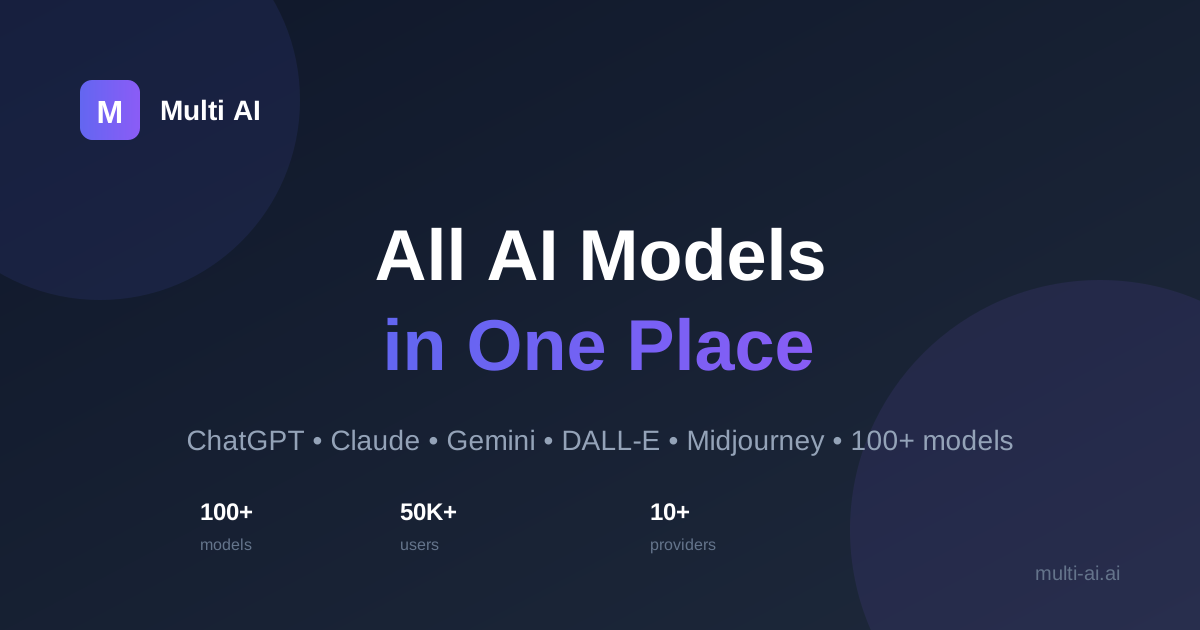
The landscape of artificial intelligence has evolved dramatically by early 2026, with an increasing demand for unified platforms that can manage and orchestrate multiple advanced AI models. Businesses and developers alike are seeking efficient ways to leverage the unique strengths of various LLMs without the overhead of juggling multiple APIs and subscriptions. This is precisely where a robust multi-AI dashboard platform becomes indispensable. Our comprehensive TEST: Multi-AI Dashboard Platform Review for 2026 delves into the capabilities, performance, and user experience of Multi AI's offering, which now boasts an impressive 49 distinct models.
As AI models become more specialized, the ability to seamlessly switch between them or even combine their outputs for complex tasks is no longer a luxury but a necessity. The Multi-AI Dashboard Platform addresses this critical need, providing a centralized hub for accessing an extensive array of cutting-edge AI technologies. From advanced coding assistants like GPT-5.2-Codex to powerful conversational agents such as Claude Opus 4.6, this platform aims to simplify the integration and deployment of AI across various applications. This review will guide you through its core functionalities and highlight its significance in the current AI ecosystem.
A Closer Look at the Multi-AI Dashboard Platform's Core Features
The Multi-AI Dashboard Platform distinguishes itself with a suite of features designed to enhance productivity and flexibility. At its heart is the unified access to 49 different AI models, eliminating the need for individual API keys and complex integrations. This aggregation capability, similar to what industry observers have noted about leading AI aggregators, allows users to experiment with various models like Gemini 2.0 Flash or DeepSeek R1T Chimera from a single interface. The platform's intuitive design ensures that even users new to AI orchestration can quickly get started.
- Unified Model Access: Connect to 49 diverse AI models from a single API, offering unparalleled flexibility.
- Cost Optimization: Intelligent routing and transparent pricing help users select the most cost-effective model for each task.
- Performance Metrics: Real-time monitoring of model latency, accuracy, and token usage.
- Seamless Switching: Easily switch between models like Qwen Plus 0728 and Claude Sonnet 4.6 to find the best fit for specific prompts.
- Developer-Friendly API: A consistent API across all integrated models simplifies development and deployment.
- Scalability: Designed to handle high-volume requests, making it suitable for enterprise-level applications.
Platform Advantage
The Multi-AI Dashboard Platform provides a distinct advantage by abstracting away the complexities of interacting with individual AI providers, consolidating diverse capabilities into one streamlined experience. This centralized approach significantly reduces development time and operational overhead for businesses leveraging multiple AI solutions.
Performance and Model Diversity: A Deep Dive into the Multi-AI Dashboard
One of the most compelling aspects of the Multi-AI Dashboard Platform is its sheer diversity of integrated models. With 49 models currently available, users have access to a broad spectrum of capabilities, from ultra-fast, lightweight models to highly complex, specialized ones. For rapid prototyping and general text generation, models like Gemma 3 4B or Step 3.5 Flash (free) offer excellent speed and cost-efficiency. When precision and advanced reasoning are paramount, models such as Qwen3.5 Plus 2026-02-15 and o1 provide superior outputs. Read also: Claude Ai vs Alternatives: Complete Comparison 2026
For specific use cases like code generation, the platform integrates specialized models such as Qwen3 Coder Next and the highly anticipated GPT-5.2-Codex. These models are specifically fine-tuned for programming tasks, offering significant advantages over general-purpose LLMs in terms of accuracy and efficiency. Similarly, for multimodal applications, the inclusion of models like GPT Audio and GPT Audio Mini opens up new possibilities for voice-enabled AI solutions. This comprehensive model selection ensures that users can always find the right tool for the job within the Multi-AI Dashboard Platform.
Optimizing Workflows with Multi-AI Dashboard Platform
The true power of the Multi-AI Dashboard Platform lies in its ability to optimize AI workflows. Instead of manually switching between different provider interfaces, developers can use a single API endpoint to access any of the 49 models. This simplifies integration into existing applications and allows for dynamic model selection based on task requirements or cost constraints. For instance, a common workflow might involve using a free model like Gemini 2.0 Flash (Free) for initial draft generation, then escalating to a more powerful model like Claude Opus 4.6 for refinement and quality assurance. This intelligent routing capabilities are becoming a hallmark of leading AI platforms, as highlighted by various industry analyses.
TEST: Multi-AI Dashboard Platform Review 2026: Use Cases
The versatility of the Multi-AI Dashboard Platform makes it suitable for a wide array of applications across different industries. Content creation agencies can leverage models like Palmyra X5 for generating compelling marketing copy, while simultaneously using Molmo2 8B for quick factual checks. Software development teams can utilize KAT-Coder-Pro V1 for complex code tasks and then switch to Qwen3 Coder 480B A35B (exacto) for code review and optimization. This dynamic model utilization significantly boosts efficiency and output quality. Read also: Best AI Models for Code Review 2026 | Multi AI
- Content Generation: Draft articles, marketing materials, and creative narratives using models like Palmyra X5.
- Software Development: Generate, debug, and optimize code with specialized models such as GPT-5.2-Codex and KAT-Coder-Pro V1.
- Customer Service: Power advanced chatbots and virtual assistants with conversational models like Kimi K2.5 or GLM 5.
- Data Analysis: Extract insights and summarize complex data using models like Olmo 3.1 32B Instruct.
- Multimodal Applications: Develop voice-enabled interfaces or analyze audio data with GPT Audio and GPT Audio Mini.
Comparison with Leading AI Platforms in 2026
In the rapidly evolving AI landscape of 2026, the Multi-AI Dashboard Platform stands out among a growing number of AI aggregators and observability platforms. While many platforms offer access to a handful of popular models, Multi AI's commitment to integrating a diverse array of 49 models gives it a significant edge. Competitors like MindStudio and other AI aggregators mentioned in recent analyses often focus on a smaller, curated selection or specific niche applications. Multi AI's breadth allows for greater flexibility and future-proofing, as users are not locked into a limited set of capabilities.
Multi-AI Dashboard Platform vs. Others (Conceptual)
| Критерий | Multi-AI Dashboard Platform | Generic AI Aggregator A | Specialized AI Platform B |
|---|---|---|---|
| Total Models | 49✓ | 10-15 | 5-8 |
| Ease of Integration | Excellent✓ | Good | Moderate |
| Cost Optimization Features | Advanced✓ | Basic | Limited |
| Developer API Consistency | Unified✓ | Varied | Specific |
| Real-time Monitoring | Comprehensive✓ | Partial | Basic |
| Free Models Available | Many✓ | Some | Few |
Furthermore, the platform's emphasis on features like intelligent routing and detailed performance metrics ensures that users can not only access a wide variety of models but also utilize them efficiently and cost-effectively. This holistic approach, encompassing both breadth of choice and operational efficiency, positions the Multi-AI Dashboard Platform as a leader in the multi-model AI space for 2026. The ability to switch between powerful options like DeepSeek V3.1 Nex N1 and more accessible alternatives like Mistral Small 3.1 24B (free) directly from the dashboard provides unmatched flexibility.
The Future of AI Integration with Multi-AI
As we look further into 2026 and beyond, the trend towards multi-model AI environments is only set to accelerate. Platforms like the Multi-AI Dashboard Platform are at the forefront of this movement, simplifying the complex world of AI for developers and businesses. The continuous integration of new and emerging models, such as rumored advancements in the Qwen series like Qwen3.5 397B A17B or the next generation of Llama models like Llama 3.3 70B Instruct (free), will ensure that users always have access to the latest and most powerful AI capabilities. The platform's commitment to a diverse, performant, and cost-efficient ecosystem makes it a critical tool for anyone serious about AI. Read also: SLM in 2026: Practical Comparison of GPT-4o-mini vs Hermes 3 for Business
Multi-AI Dashboard Platform
Pros
- Access to 49 diverse AI models from a single API.
- Excellent cost optimization features with intelligent routing.
- Consistent API simplifies integration for developers.
- Real-time performance monitoring and analytics.
- Supports a wide range of use cases from coding to content generation.
- Includes many free and open-source models for experimentation.
Cons
- Initial learning curve for new users navigating 49 models.
- Potential for decision fatigue with too many model choices for simple tasks.
- Reliance on third-party model providers, subject to their updates.
- Advanced features may require some technical understanding.
Frequently Asked Questions about the Multi-AI Dashboard Platform
Frequently Asked Questions
Verdict
The Multi-AI Dashboard Platform stands out as the premier solution for managing and orchestrating a diverse array of AI models in 2026. Its extensive model library, intuitive interface, and robust feature set make it an invaluable tool for developers and businesses seeking to harness the full potential of AI. The platform's commitment to flexibility, cost-efficiency, and performance ensures it remains a leader in the multi-model AI space.